

To Have and To Hold: Nature's Hidden Relationships
An Interview with Sophie Pavelle


TMR - To Have or To Hold approaches ecology through the lens of symbiosis. How were you first drawn to these hidden partnerships as a vehicle for discussing resilience and cooperation in the age of climate breakdown and mass extinction?
SP - Studying Zoology at university introduced me to the complex, captivating world of symbiotic relationships through modules that explored parasitism and social insect behaviour. I was always drawn to the alien side of nature – loved the things others didn’t. When I later returned to symbiosis, unprovoked and by chance a few years ago, I was viewing it through a different lens. In the years since I had first studied, the world had changed dramatically. I noticed a juxtaposition of a greater awareness of nature’s fragility and an urge to address concerning environmental disconnect, alongside confusion around political action on climate change and biodiversity loss. Our connectivity to the natural world, and to one another, is more pertinent than ever, and it just so happened that reintroducing myself to symbiosis and nature’s hidden relationships and spectacular resilience offered timely lessons for us to heed.
TMR - The book explores eight striking case studies – from the “mint-sauce worm + algae” fusion to the “lungwort lichen throuple.” How did you come to settle on these?
SP - I thought it would be difficult to find relationships that would profile the narratives of beauty and brutality; loyalty and exploitation, that I wanted to explore. It was important to me that these relationships existed around my home, the British Isles, were accessible by public transport as much as possible for readers, but portrayed stories and issues of global significance. I wanted species that would get me in the sea, under forest canopies, in ancient grasslands and poking around in soil and rock pools. And it turned out that, as is always the case with nature – the more you look, the more you see! Symbiosis and species living in these dynamic alliances are everywhere you look – from soil to sea to sky. All animal life hosts some form of parasite, and all life lives in symbiosis – connected to one another.
The relationships that I profile in To Have or To Hold are a mixture of personal obsession, academic/expert recommendation, and pure chance on a late-night internet stumble. There are always more I could have chosen, but I am happy with how these eight relationships play off one another – each offers a lesson that links to the next chapter and back again... much like symbiosis itself.
TMR - Each chapter is framed playfully – “relationship status: friends with benefits,” “it’s complicated,” “unhinged.” What was the process behind your decision to present rigorous science through this narrative device?
SP - The conservation sector and natural history genre can run into claustrophobic territory with the audiences they engage. Having worked directly in both sectors since I left university, I am conscious of how easily we preach to the choir with conservation messaging, data, facts, and suggested action for nature.
My goal with science communication is to approach it with constant inquiry and curiosity about the audience: what do they love? What do they hate? What do they do in their spare time? What’s going to make them emotional? What will make them care? It’s an ongoing challenge I enjoy experimenting with (with much error!), but pivoting To Have or To Hold around the universal occupation of ‘relationships’ suddenly seemed like a fun opportunity to disrupt the rigour and expectation of a ‘science’ or ‘nature book’ and nod to the language, form, and presentation of relationships that pervade popular culture.
Some readers who want a more traditional, binary non-fiction narrative aren’t fans – but others have found it super engaging. I’ve loved hearing from readers who write to me saying how ‘seen’ they’ve felt in my writing because of these fun little creative details. I also just had so much fun coming up with them and adding play into the manuscript like this – it helped me balance the heavyweight elements and made it all feel more achievable. I think we are all enjoying ourselves when we’re learning and laughing – especially when it comes to climate science!
TMR - Building from the previous question – some of the relationships are described in distinctly human terms. Were you ever concerned that personifying the relationships might risk simplifying or diminishing them in some way?
SP - I never felt concerned, personally. Quite the opposite - I felt emboldened by the power of this linguistic decision defying such an academic and scientific taboo. Speaking of nature and writing of the living world using a grammar of animacy is a growing movement which, I believe, is truly of service to nature. Writing myself alongside other species as equal, referring to them as ‘who’, ‘he’, ‘she’, ‘they’, deepens my connection to them. As I muse in the prologue, some of these relationships I explore are so complex that I couldn’t hope to understand them and share their significance with the reader if I distanced myself from them in language.
This book is as much about our relationships - between other people and between us and nature - so connecting myself through language seemed like a no-brainer and a natural fit for a narrative that I hope communicates gritty science with warmth and femininity. Despite much pushback and voiced concern by some of the academics I worked with during the writing/research process, I held my ground, inspired all the time by luminaries who have honed animacy to an art in prose, like Robert Macfarlane and Robin Wall Kimmerer. For me, nature will never be ‘it’.
TMR - A distinctive feature of the book is the way you travelled low-carbon around the British Isles to encounter these ecosystems. How were you affected by travelling in a slower, more deliberate way, and what effect do you feel this choice had on both the book and you as a writer?
SP - After experimenting with it during the process of writing and researching my first book, Forget Me Not, travelling in this way became a sure-fire way to not only help give me narrative material that wasn’t deep science but to speak with the reader and give them trip ideas. I love reading a book that I can contextualise by seeing landscapes and landmarks for myself, so I hoped to be able to inspire readers to maybe try and replicate some of the journeys.
Also, if I’m going to try and write accurately about nature and the wild challenges species endure, if I can experience even an ounce of that through physically pushing myself and moving slowly through the same landscape, then I feel I can translate their story better onto the page once I’m back home! I also just love weather, and though I’m a planner, I seem to thrive in the unpredictability of adventure travel and feel grateful I’m able to have the editorial space to share those moments with readers.
TMR - Fundamentally, in this book you are dealing with urgent environmental themes – how do you manage to enjoy yourself, indulge your curiosity, and revel in the wonder of discovery while also addressing the more grave subject matter?
SP - This is important to me. Whilst the subject matter of To Have or To Hold utterly gripped me in its talons with its fascination and intellectual challenge, to the point where I became obsessive and struggled to keep boundaries between writing and my home life - if I hadn’t maintained other interests throughout, I would have descended into quite a dark place, I think.
Fitness and physical challenge have always been my brain break and inspiration - be it trail running, gravel riding for hours on the moors or heathland with my friends, or sea swimming - physical, full-body immersion outdoors through all weathers keeps me sane and helps me write. I read fiction, watch a lot of TV, go to the theatre where possible, and try to dissect how novelists and screenwriters do it – because at the end of it all, I just want to write a good story - and they know it best.
Finally, I love food. I’ve always thought that if I didn’t work in science communication, I would have loved to be a chef or work in the culinary industry. Cooking at home from scratch, losing myself in a recipe or disobeying it altogether, has always helped me unwind and detangle from an intense writing day.
TMR - Parasitism recurs throughout the book as “a cunning blend of bargaining and exploitation.” What do you hope readers will take from this - particularly in reflecting on whether we as humans act as parasites?
SP - Parasites siphon resources from their hosts and can cause suffering to ensure their own survival. This behaviour has given them a culturally bad name. But through their devilish methods, they maintain an astonishing ecological stability, offering invaluable lessons for us.
A bad parasite kills their host. A smart one stays with them - even to the point where a host can survive and reproduce whilst dealing with a parasitic invasion. Parasites, in their own way, have finessed reciprocity and restraint, taking only what they need and often creating ecological opportunity in the process. Over half of all animal life thrives in a parasitic relationship, which tells me they know a thing or two about relationship management and longevity. Our treatment of the natural world is so concerning that it’s got to the point where we should be looking at parasites and asking ourselves: hello, what can you teach us? How can I be a better parasite and forge a more sustainable relationship with nature? Parasites offer us a chance for ecological humility, and I find that very exciting.
TMR - You’ve described rewilding not as a nostalgic return but as “positive disruption” - embracing change to enable regeneration. What role do the symbiotic stories you tell have in shaping your vision of what rewilding can offer in the future?
SP - I hope the way I’ve presented symbiosis is a positive disruption to the more commonly understood concept of it being defined by harmony and mutualism. On the basis of modern science and unfolding data, I propose it to be a governing life force that is much darker, more shocking, and beautifully complex than we ever imagined – nature at her brightest and most formidable. Symbiosis is best understood as an all-encompassing, interconnected view of our planet. Similarly, rewilding encourages a holistic approach that regards the planet as a whole, of countless moving parts that self-regulate and work together. Rewilding is about trust, in one another as advocates and custodians, but also placing trust in nature, that it can achieve balance and sustain it – if we let it.
TMR - If one of the eight case studies were to serve as a model for future conservation efforts, which would you choose, and why?
SP - The trio of participants that make the stunning body of the lungwort lichen is as close to mutualism as I could find. There is a remarkably sustainable flux of resources, of give and take, of something fascinating called ‘reciprocal parasitism’, which affords immense stability in the relationship. I think this could be quite an accurate translation of a productive but realistic model of successful conservation projects… trust, give and take, collaboration leading to a hopefully flourishing life!
TMR - At The Marlowe Review we are drawn to the relationships and symbioses between people, places, and the natural world. How important was the land through which you travelled - coastlines, grasslands, forests - in shaping the stories, and did you form any personal connections there that don’t appear in the book?
SP - Every landscape had value, and I felt very lucky to include and travel to such a variety from my doorstep. I felt drawn to Jersey and the Channel Islands for their novelty and beauty, and also developed a very emotional connection to Ireland and the temperate rainforest landscapes I explored there. I can’t quite put my finger on it... but I left a piece of myself in Ireland and hope to return soon.
TMR - Finally, our magazine often returns to the theme of journeys, both literal and metaphorical. Looking back now at To Have or To Hold, what journey do you hope it might inspire in your readers?
SP - That we are joyfully, complicatedly, inextricably part of the story.
A Note on the Author and the Book:
Sophie Pavelle is a US-born and UK-based science communicator. She worked for Beaver Trust and presented their award-winning documentary Beavers Without Borders. She is an Ambassador for The Wildlife Trusts and sat on the RSPB England Advisory Committee. Her writing has appeared in The Guardian, National Geographic Traveller, New Scientist, The Independent and BBC magazines. Her first book, Forget Me Not, was widely praised for encouraging action against climate change and biodiversity loss.
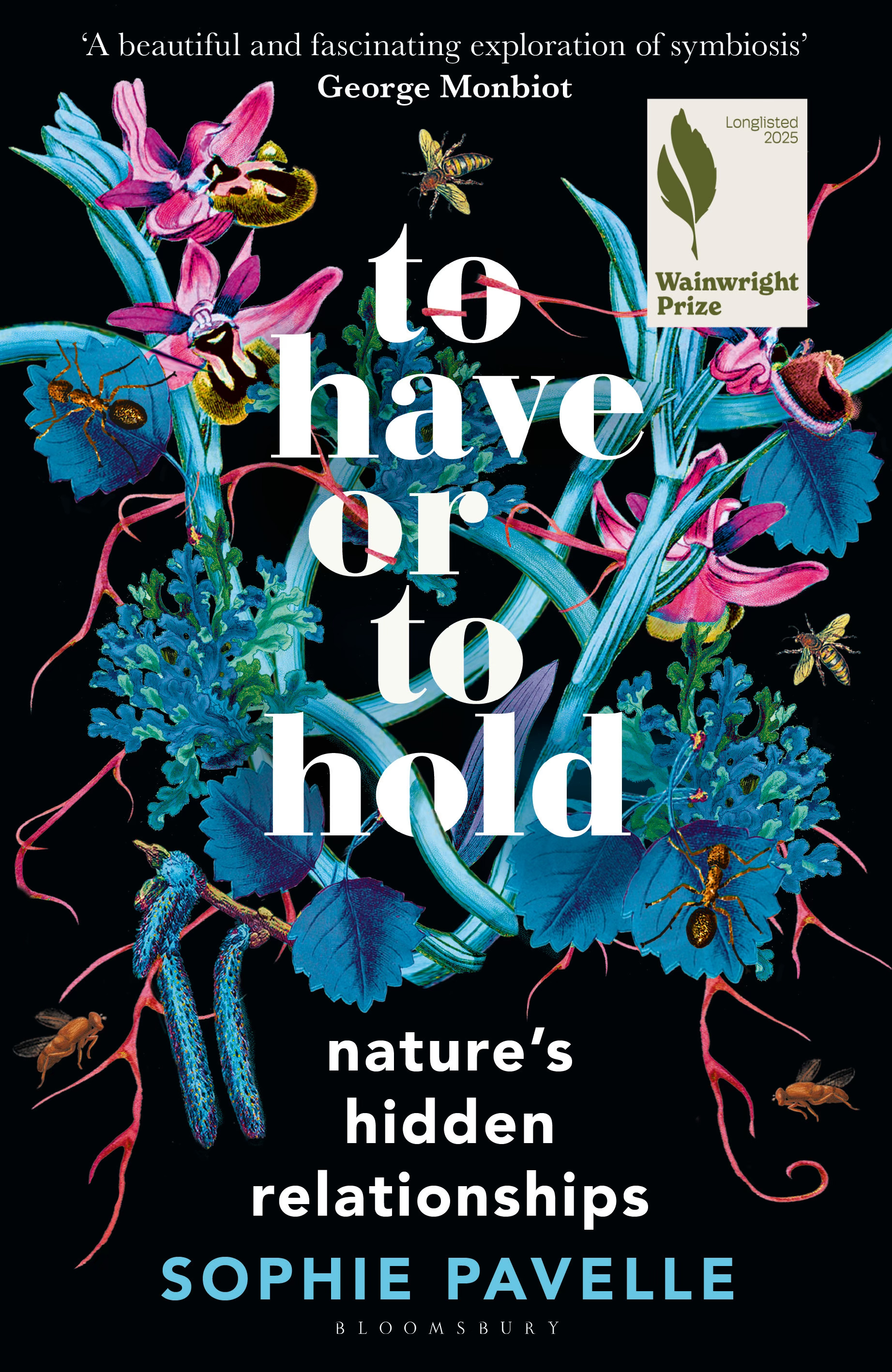
To Have or To Hold : Nature’s Hidden Relationships is a thrilling exploration of nature’s symbiotic relationships, some comforting and familiar, others wildly alien, by the award-winning author of forget me not. What can nature teach us about living together? Investigating eight symbiotic relationships trying to survive the climate and biodiversity crises, Sophie Pavelle explains why it has never been more vital for us to understand symbiosis. Symbiotic relationships regulate ecosystems, strengthen resilience and bind pivotal connections. Species living together in symbiosis is no accident – these dynamics evolved. Species form and sever alliances everywhere, from deep within temperate rainforests to the open ocean, quiet tidal pools or chalk grasslands, and nature thrives on relationships as glamorous as they are grotesque and as bizarre as they are engrossing. In To Have or To Hold, Sophie relishes the interconnectedness between species and celebrates the relationships that underpin natural environments. Low-carbon travelling around the British Isles, she presents nature’s frauds, fortune-tellers, misfits and cheaters. The natural world is built on parasitism, a cunning blend of bargaining and exploitation in the name of survival. In our relationship with the natural world, are we the parasites? Will we continue to exploit nature’s resources? Or will we vow to love and cherish what remains – shaping a more restorative life alongside nature – till death us do part?
To Have or To Hold: Nature’s Hidden Relationships by Sophie Pavelle is published by Bloomsbury Wildlife, £20.00
 | A guest post by
|
Hey, great read as always, this concept of nature's hidden relationships and spectacular resilience totally clicked with me, kinda like how my Pilates instructor always says our body's tiny muscles work in symbiosys to keep us upright and strong!